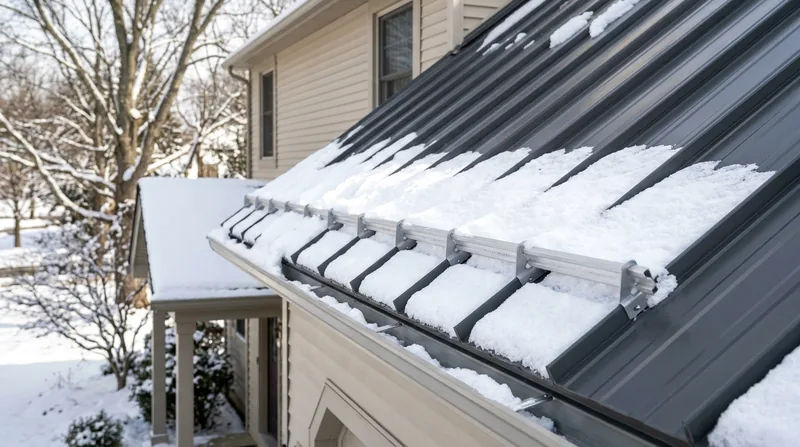




Snow Guards & Ice Protection in Cleveland
If you own a metal roof in Cleveland, you already know the panels shed snow fast. That is a big part of why you chose metal over shingles. But when 8 to 12 inches of lake-effect snow lets go all at once above a front walk in Ohio City or a driveway in Lakewood, the result is a sliding wall of ice and snow that can dent a car, tear a gutter, and put a family member in the ER. Snow Guards & Ice Protection in Cleveland is the fix: we mount retention hardware and address the eave detail so snow releases in small, controlled pieces instead of one dangerous slab. Cleveland's 1890s Victorians in Tremont, the steep gabled doubles in Slavic Village, and the Tudor Revivals in Shaker Heights all sit under the same freeze-thaw cycle that makes ice dams and sudden snow release a yearly problem. We size, space, and anchor the system to your specific panel profile and roof pitch. You can see how we handle the full envelope on our metal roof installation page.
Why Snow Guards Matter on a Northeast Ohio Metal Roof
Cleveland sits on the south shore of Lake Erie, and the lake-effect machine does not quit until March. Add the freeze-thaw cycles that hit every January and February, and a bare metal panel becomes a launch ramp. The failure mode that dominates here is not slow melt. It is the sudden release of a snowpack that has been sitting for weeks, softened at the base, and then let go in one sheet off a 7/12 or 9/12 pitch. That is why retention hardware is standard practice on standing seam and exposed-fastener roofs in this climate, not an upsell.
- Snow slides off in a single sheet on slick standing seam panels and can crush gutters, AC units, and porch steps below.
- Ice dams form at the eave when attic heat melts the underside of the snow and it refreezes at the cold overhang, backing water under the panels.
- Valleys and dormers concentrate the load on cut-up rooflines common in Solon, Avon, and Medina subdivision homes.
- Lower roofs and walkways take the hit on the steep gabled doubles and Craftsman bungalows across Detroit-Shoreway and Collinwood.
- Gutters and downspouts tear loose when a sliding snowpack catches the hanger and pulls the run off the fascia.
Every one of those problems has a hardware answer, and the right answer depends on your panel type, pitch, and what sits below the eave.
Key info: A homeowner in Cleveland Heights with a standing seam roof over a brick Tudor had snow release take out a section of gutter and dent a parked car in the driveway. We added a bar-style retention system across the two lower roof planes and re-hung the gutter with heavy-duty hangers. No more avalanche, no more dents.
For the code side of the work, the City of Cleveland Division of Building and Housing handles residential roofing permits, and your local building department sets the thresholds. You can verify current requirements at the City of Cleveland Building and Housing page before any work starts.
How We Install Snow Guards and Ice Protection on Cleveland Roofs
We do not guess at spacing. We measure the panel, the pitch, the snow load the roof will see, and what is underneath the eave before we order a single bracket. On a standing seam roof we use non-penetrating clamps that grip the seam so the panel warranty stays intact. On an exposed-fastener corrugated or ribbed roof we fasten through the high rib with proper sealing washers. Then we look at the ice side: ventilation, eave detail, and whether the drip edge is letting water back in.
- We inspect the roof and eave to map where snow and ice actually land, including driveways, entries, and lower roof planes.
- We identify the panel profile and pitch so the retention hardware matches the roof instead of fighting it.
- We calculate layout and spacing based on roof slope and the snow load typical of the Cleveland area.
- We install the guards or rail system with the correct clamps, brackets, and sealant for your metal type.
- We address the ice-dam side by checking intake and exhaust ventilation and the eave flashing detail.
- We walk the roof with you at the end and show you what to watch for during the first big lake-effect dump.
The result is a roof that sheds snow in small, predictable pieces and a drainage path that keeps meltwater moving off the roof instead of backing up under it.
Key info: On a 1920s frame bungalow in Parma with a low-pitch exposed-fastener roof, the homeowner had ice backing up under the panels every February. We added a row of snow guards above the entry and corrected the eave ventilation, which stopped the melt-refreeze cycle at the source. The same fix works on the Cape Cods and ramblers across Euclid and Garfield Heights.
If the eave detail needs work beyond retention hardware, we handle that alongside the guards. See our gutters for metal roofs page for how we tie the drainage run into the retention layout.
Retention Approaches We Use on Cleveland Metal Roofs
There is no single product that fits every roof. The right choice depends on panel type, pitch, and whether you want maximum holding power or a lower-profile look. Here is how the main options compare for Northeast Ohio conditions.
| Approach | Description | Best for |
|---|---|---|
| Seam-mounted snow guards | Non-penetrating clamps grip the standing seam and hold individual pad-style guards. | Standing seam roofs where the panel warranty must stay intact. |
| Snow retention rail (bar system) | A continuous horizontal bar mounted above the eave holds the snowpack in place until it melts. | Steep pitches and roofs above driveways, entries, and walkways. |
| Pad-style guards on exposed-fastener panels | Brackets fasten through the high rib with sealed washers and hold individual pads. | Corrugated and ribbed roofs on Cape Cods and ramblers. |
| Ice-dam ventilation and eave correction | We improve intake and exhaust airflow and correct the eave flashing to stop melt-refreeze. | Homes with recurring ice dams despite retention hardware. |
| Color-matched guards and trim | Guards and rails finished to match the panel color for a clean roofline. | Historic districts and HOA-governed subdivisions. |
We match the approach to the roof in front of us, not to a catalog page, and we tell you plainly when a rail system is overkill or when pad guards alone will not hold.
Snow Guards & Ice Protection Cost in Cleveland: What to Expect
Most residential snow guard jobs in the Cleveland area start around $1,200 and climb from there. That starting figure typically covers a straightforward run of guards over one entry or one lower roof plane on a standard panel profile. The number moves up with roof height, pitch, the length of the run, and whether you need a full rail system instead of individual pads. A steep 10/12 roof on a Shaker Heights Tudor takes more hardware and more time than a low-pitch rambler in Parma, and the price reflects that.
Ice-dam correction adds cost when ventilation or eave flashing needs rework. Color-matched finishes and HOA-compliant profiles can add a bit more. We give you a written scope so you can see exactly what drives the number, and we recommend getting two or three estimates on any job of this size. Our pricing overview breaks down how we build those numbers.
Snow Guards & Ice Protection Near Me: How to Choose a Contractor Near Cleveland
Metal roofing is a specialty, and snow retention hardware is a specialty within it. Plenty of general roofers will quote the job, but few have installed seam clamps on a standing seam panel or know how spacing changes with pitch and snow load. Here is what to check before you sign.
- Confirm the contractor is licensed and insured and ask for a certificate of insurance before work begins.
- Get two or three written estimates that list the hardware, spacing, and scope, not just a lump sum.
- Ask for references from metal roof owners in Cleveland, Lakewood, or Shaker Heights and call them.
- Check who pulls the permit with the local building department and confirm the threshold for your project.
- Ask about historic district and HOA design review if your home is in a protected neighborhood or subdivision.
A contractor who can answer those questions without hedging is the one you want on your roof. Reach us through our contact page to set up an inspection.
Snow Guards & Ice Protection in Cleveland: Pricing Guide
| Service | Price | Details |
|---|---|---|
| Snow guards over one entry or lower roof | Starting at $1,200 | Covers a standard run of pad or seam-mounted guards on one roof plane; height and pitch move the price. |
| Full rail system on a steep roof | Starting at $2,400 | Continuous bar retention across the eave; steeper pitches and longer runs raise the total. |
| Ice-dam ventilation and eave correction | On estimate | Needs an on-site look at attic ventilation, eave flashing, and panel detail before a number is given. |
| Complex or large-scale job | On estimate | Cut-up rooflines, multiple roof planes, and color-matched HOA profiles require a full site walk first. |
| Travel | Included | In Cleveland and surrounding areas, no separate call-out or mileage fee. |
| Estimate | Free | Response within 24h at (216) 294-3900, no obligation to book. |
Indicative pricing, the exact cost depends on square footage, finish, and site access. Free personalized estimate within 24h at (216) 294-3900.


